Dere Types Explained
A dere type describes how an anime character acts toward the person they love. This page explains all 20 common types of dere: what each name means, how to tell the similar ones apart, and characters who show them best. To find your own type, the dere type test scores you on the 8 main ones.
Last updated: November 27, 2026
The 8 main dere types
These are the types you will see named most often in anime discussions, and the ones scored by our dere type test.
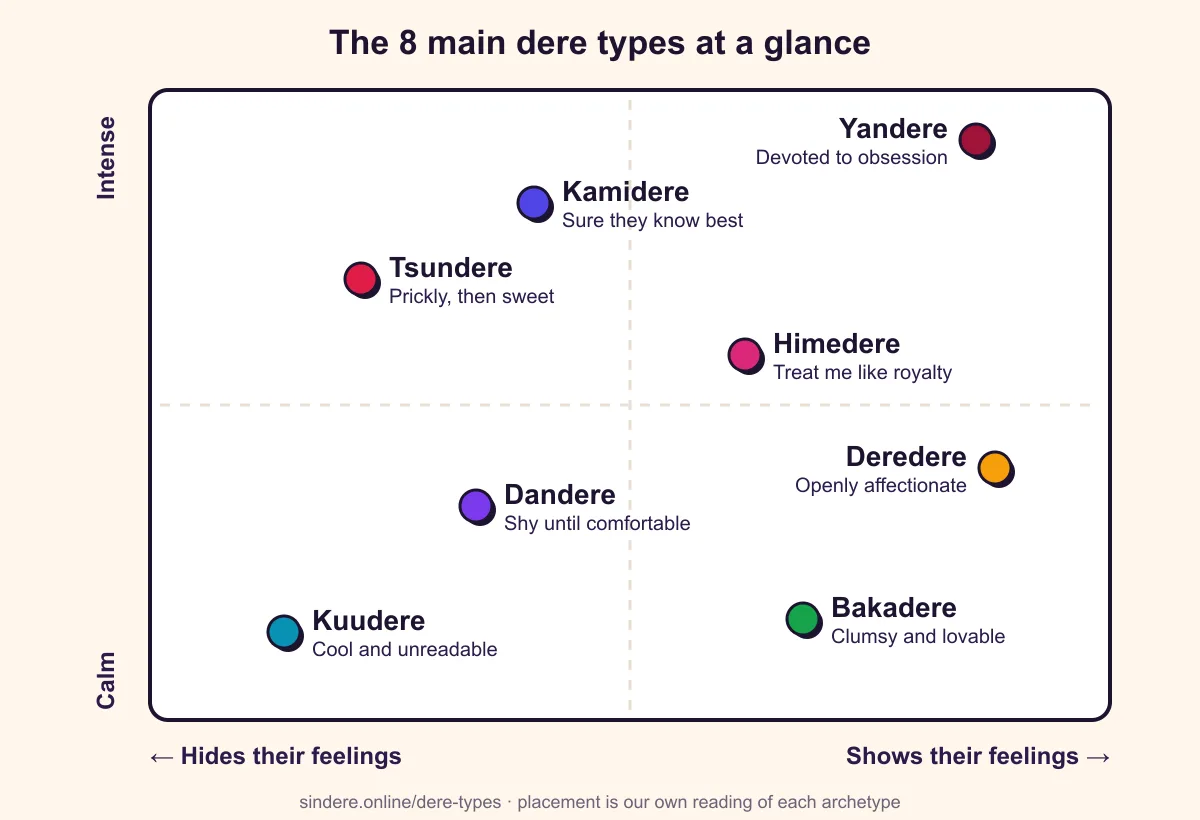
| Type | Name comes from | In love, they… | Classic examples |
|---|---|---|---|
| Tsundere | tsuntsun, curt or prickly | Act cold or rude, then show they care | Taiga Aisaka (Toradora!), Asuka Langley (Evangelion) |
| Yandere | yanderu, to be sick | Love sweetly, then obsessively | Yuno Gasai (Future Diary), Ayano Aishi (Yandere Simulator) |
| Kuudere | kuuru, cool | Stay calm and blunt, warm in private | Rei Ayanami (Evangelion), Mikasa Ackerman (Attack on Titan) |
| Dandere | danmari, silent | Go quiet from shyness, open up slowly | Hinata Hyuga (Naruto), Shoko Komi (Komi Can't Communicate) |
| Deredere | deredere, lovey-dovey | Are openly cheerful and affectionate | Tohru Honda (Fruits Basket), Orihime Inoue (Bleach) |
| Himedere | hime, princess | Want to be treated like royalty | Erina Nakiri (Food Wars!), Sena Kashiwazaki (Haganai) |
| Kamidere | kami, god | Are arrogant, commanding and sure they are right | Light Yagami (Death Note), Haruhi Suzumiya |
| Bakadere | baka, silly | Are clumsy, chaotic and sweet | Aqua (KonoSuba), Tamaki Suoh (Ouran High School Host Club) |
Tsundere
The most famous dere type. A tsundere starts out tsun: irritable, proud, quick to deny any feelings ("It's not like I like you or anything!"). Over time the dere side shows through small kind acts they would never admit to. There are two common variants: tsun-heavy characters who are mostly harsh, and dere-heavy ones who are mostly soft with a short temper. Test yourself with the tsundere test.
Yandere
A yandere looks like a devoted, sweet partner. The twist is that the love is possessive: rivals are threats, and in darker stories the character will hurt anyone who gets in the way. In everyday fan use, "a bit yandere" just means very jealous or clingy. See how much of it you have with the yandere test.
Kuudere
Cool, composed and expressionless. A kuudere rarely raises their voice, says exactly what they mean and seems unbothered by things that rattle others. Their affection comes out in quiet loyalty and the occasional rare smile.
Dandere
Shy rather than cold. A dandere can barely speak to strangers or crushes, but with the right person becomes talkative, funny and caring.
Deredere
All dere, no twist. A deredere is warm, upbeat and affectionate with everyone, and makes no secret of their feelings.
Himedere
A self-styled princess. Himedere characters expect to be pampered and admired and can seem spoiled, but they are generous and sweet to people who treat them well.
Kamidere
Godlike confidence. A kamidere is arrogant, ambitious and convinced they know best. Love tends to catch them off guard, because it is the one thing they cannot control.
Bakadere
Lovably silly. A bakadere is clumsy, impulsive and often oblivious, and their honesty and enthusiasm are a big part of their charm.
Those are the 8 types the dere type test scores. Tsundere and yandere also have their own tests that measure how strong the trait is, from 0 to 100%.
12 rarer dere types
These names are used in fan communities but less consistently. Definitions vary from site to site, so treat them as loose labels rather than fixed categories.
| Type | Meaning |
|---|---|
| Mayadere | An antagonist or enemy who falls for the protagonist and sometimes switches sides. Esdeath from Akame ga Kill! is the usual example. |
| Undere | Agrees with everything the person they love says, from un, an informal "yes". |
| Sadodere | Shows affection by teasing, bullying or enjoying the other person's embarrassment. |
| Kanedere | Interested in someone mainly for their money or status, from kane, money. |
| Hinedere | Cynical and cold, with a hidden soft spot; often described as a darker cousin of kuudere. |
| Darudere | Lazy and unmotivated, but makes an exception for the person they love, from darui, sluggish. |
| Shundere | Sad or melancholy, and in love despite it. |
| Utsudere | Struggling with depression; love is complicated by it. |
| Goudere | Will do anything to please the person they love, often to an over-the-top degree. |
| Kekkondere | Wants to marry the person they like right away, from kekkon, marriage. |
| Oujidere | A prince-like character, the male counterpart of himedere, from ouji, prince. |
| Byoudere | Physically ill or fragile, which shapes how they love, from byou, illness. |
How to tell similar dere types apart
- Tsundere vs. yandere: a tsundere hides their love behind attitude; a yandere shows it openly, and the problem is how far they will go to keep it.
- Kuudere vs. dandere: a kuudere is calm by nature; a dandere goes quiet from nerves. Put them with friends and the dandere starts talking, while the kuudere stays the same.
- Himedere vs. kamidere: a himedere wants to be treated as special; a kamidere believes they are above everyone. One wants a throne, the other thinks they already sit on one.
- Tsundere vs. kuudere: both look distant, but a tsundere is hot-tempered and a kuudere is unbothered. If they blush and yell, tsundere; if they shrug, kuudere.
Where dere types come from
The terms grew out of Japanese otaku slang. Tsundere was in use among fans of visual novels and dating sims by the early 2000s and spread widely with anime like Toradora! and The Melancholy of Haruhi Suzumiya. Other names followed by the same pattern, adding dere to a word that describes the twist. Because the system is fan-made, new types appear all the time and many characters fit more than one.
Find your own dere type
Reading about types only goes so far. Our free dere type test asks 16 questions about how you act around people you like and scores you on all 8 main types, so you can see your main type and how close the others are. If one type stands out, go deeper with the yandere test or the tsundere test.
Dere types FAQ
How many dere types are there?
There is no official count. Fans have coined dozens of names, and fan wikis list well over 20. Eight are widely used in anime and manga: tsundere, yandere, kuudere, dandere, deredere, himedere, kamidere and bakadere. This page covers those plus 12 well-known rarer types.
What does dere mean in Japanese?
Deredere is a Japanese onomatopoeia for being lovestruck or lovey-dovey. Fans attach dere to another word to describe a style of love: tsun (curt), yan (sick), kuu (cool), dan (silent).
What is the most popular dere type?
Tsundere is the best known and the one most often used in anime romance. Yandere is the most talked about outside anime, thanks to characters like Yuno Gasai and games like Yandere Simulator.
What is the difference between kuudere and dandere?
A kuudere is calm and emotionless by choice and speaks bluntly. A dandere is shy: they go quiet because they are nervous, and become chatty once comfortable. Kuudere is cool; dandere is anxious.
Is there an official list of dere types?
No. Dere types are fan terminology, not an official classification from any studio or publisher, so names and definitions vary between sites.
Which dere type am I?
Take our free dere type test. It scores you on the 8 main types and shows a percentage for each, so you can see your main type and your second one.